No Exemptions: The EU, Japan, and Canada Are Now Targets of the U.S. Forced Labor Probe
TRADE POLICY & GLOBAL COMMERCE
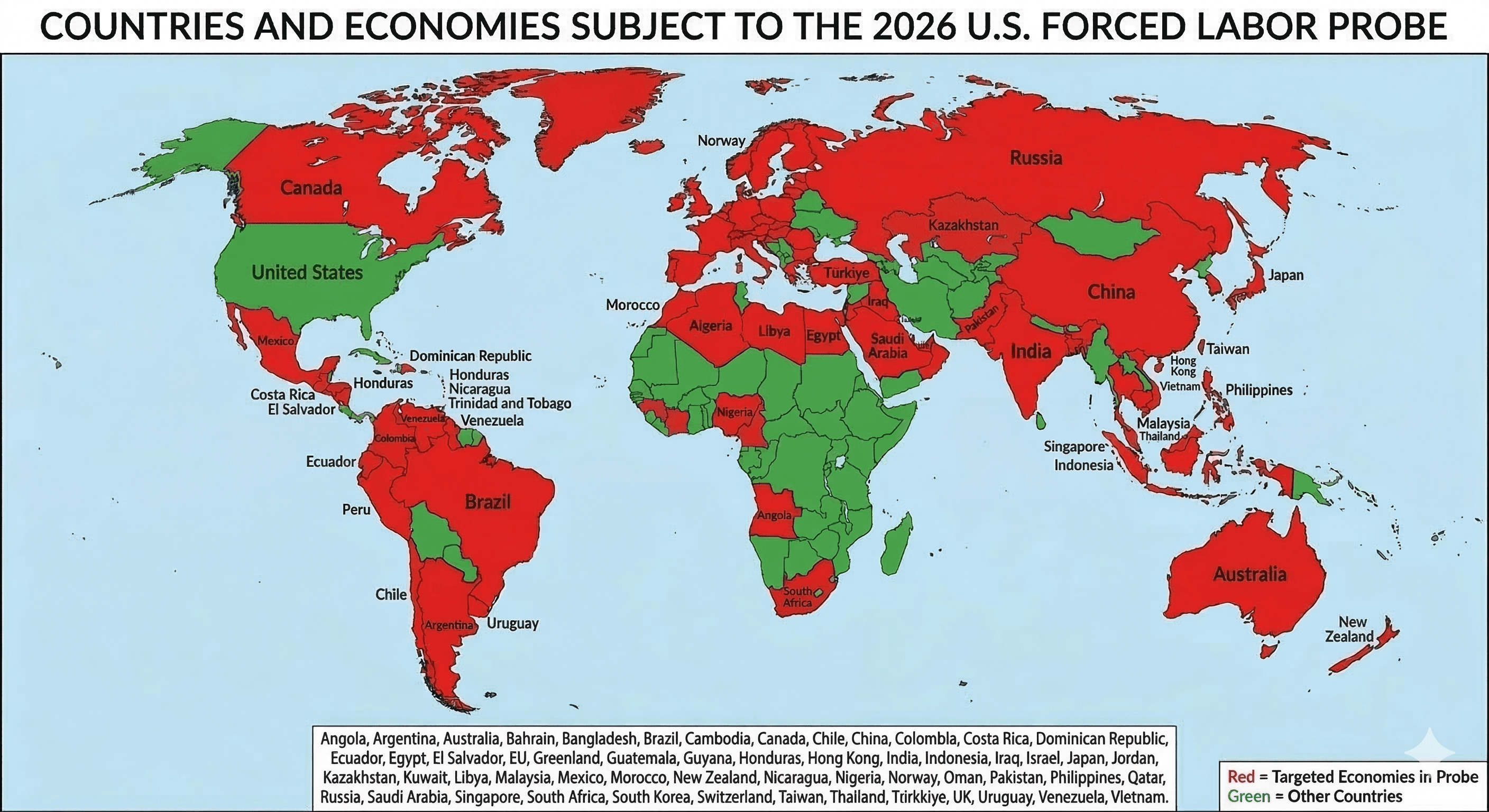
The USTR's sweeping Section 301 investigation names 60 economies — including some of the world's largest — for failing to ban imports of goods made with forced labor. Here's why that matters.
Analysis | March 13, 2026
When the United States Trade Representative launched investigations into 60 economies on March 12, 2026, the news was framed primarily as a tariff pressure play. But buried inside the announcement is a more principled argument: that countries unwilling to ban goods produced with forced labor are distorting global trade, and that even wealthy, democratic allies are not immune from that charge.
The probes, initiated under Section 301(b) of the Trade Act of 1974, mark a sharp escalation in Washington's approach to forced labor in global supply chains. They don't merely target authoritarian states known for exploitative labor practices. They target the European Union. They target Japan. They target Canada, Australia, South Korea, and a host of other advanced economies that long considered themselves partners of U.S. trade enforcement.
The Core Allegation: You're Creating a Secondary Market
Under Section 301(b), the USTR can investigate foreign acts, policies, or practices that are "unreasonable or discriminatory" and that "burden or restrict U.S. commerce." The administration's argument is that when a country lacks a forced labor import ban, it functions as a permissive market — one where goods tainted by exploitation can flow freely, compete unfairly against legitimately produced alternatives, and ultimately disadvantage American workers and firms.
The U.S. has had its own forced labor import ban baked into trade law for nearly a century, and has in recent years significantly expanded and enforced that prohibition. The logic — that goods made with coerced labor should not enter American markets — is now being turned outward: if your country doesn't have an equivalent prohibition, you may be enabling a workaround for exactly the kind of trade practices the U.S. has spent decades trying to stop.
U.S. Trade Representative Jamieson Greer put it bluntly: American workers and firms have for too long been forced to compete against foreign producers who may hold an artificial cost advantage derived from exploited labor. The investigations aim to determine whether trading partners have taken sufficient steps to address that structural problem.
Major Economies Under the Microscope
Perhaps the most striking aspect of the investigation list is the company it includes: alongside expected targets like Russia, Bangladesh, and Vietnam sit advanced industrialized economies that collectively represent the vast majority of global GDP. Their inclusion sends a clear signal: the probe is not a diplomatic cudgel aimed at developing nations — it is a structural critique of the global trading system's failure to enforce its stated values.
European Union
The EU is Washington's most symbolically loaded inclusion. The bloc has long positioned itself as a global leader on human rights and sustainable trade, and it has implemented corporate due diligence legislation (the EU Corporate Sustainability Due Diligence Directive) requiring companies to identify and address forced labor in their supply chains. But "due diligence" requirements and an actual import ban are materially different instruments. The EU's framework places obligations on companies, not customs authorities. Goods made with forced labor can still clear European ports if no company has triggered a reporting obligation — a gap the U.S. appears unwilling to ignore.
Japan
Japan is the world's fourth-largest economy and one of the United States' closest security allies. Its inclusion underscores that the probe is not defined by geopolitical alignment. Japan has adopted voluntary supply chain guidelines and participates in international frameworks on forced labor, but it has no statutory import ban equivalent to the U.S. forced labor import ban. As a major importer of electronics, textiles, and manufactured goods from regions with documented forced labor problems, Japan's regulatory gap is meaningful.
Canada
Canada's inclusion is particularly noteworthy given that it is party to the United States-Mexico-Canada Agreement (USMCA), which contains labor provisions and commits signatories to prohibit the importation of goods produced by forced labor. Canada passed the Fighting Against Forced Labour and Child Labour in Supply Chains Act (S-211) in 2023, requiring large companies to report on forced labor risks — but reporting requirements are not the same as an enforceable import ban. The U.S. apparently views the gap between Canada's disclosure regime and a true prohibitive measure as a potential trade distortion, USMCA notwithstanding.
Australia
Australia has a Modern Slavery Act (2018) that mandates reporting for large entities on modern slavery risks in supply chains. Like Canada's law, however, it is built around transparency and corporate accountability rather than border enforcement. Australia has no customs-level mechanism to block imports of goods tainted by forced labor. Given Australia's position as a major trade partner with several economies subject to the U.S. forced labor import ban, this gap has practical implications that the USTR appears to be scrutinizing directly.
South Korea
South Korea is a major manufacturing economy with deep supply chain integration across Southeast Asia. It has developed human rights due diligence guidelines for companies, but lacks a mandatory import prohibition on forced-labor goods. The country imports significant quantities of intermediate goods from Malaysia, Vietnam, and other regions with documented forced labor exposure. Seoul's absence of a border enforcement mechanism means those supply chain risks translate directly into market access questions.
India
India's situation is more complex. While India is itself a country where forced labor and bonded labor have been documented — particularly in agriculture, brick kilns, and the garment sector — its inclusion on a list focused on import bans raises a different dimension: India as a transit and finishing economy. As global companies have sought to diversify supply chains away from certain regions subject to the U.S. forced labor import ban, India has absorbed significant manufacturing investment. Without a robust forced labor import ban of its own, India could become a conduit for goods whose inputs carry exploitation risks regardless of where final assembly occurs.
Mexico
Mexico is the United States' largest trading partner by volume and, like Canada, a USMCA signatory. Its inclusion alongside Canada raises pointed questions about the durability of commitments made under the trade agreement. Mexico has faced scrutiny over labor conditions in key export sectors including automotive, agriculture, and apparel, and has implemented significant labor reforms under USMCA's rapid-response mechanism. But those reforms address domestic labor standards — not the importation of goods made with forced labor elsewhere. Mexico's role as a major assembly hub for goods with components sourced from regions subject to the U.S. forced labor import ban makes its own regulatory framework particularly consequential.
The Secondary Market Problem
When the U.S. enforced its forced labor import ban against goods from certain regions, it created an incentive for those goods to be re-routed through third countries with less rigorous border enforcement. Goods blocked from entering the United States can find buyers in markets that lack equivalent prohibitions — effectively rewarding regulatory permissiveness and undermining the deterrent effect of the U.S. ban.
A world in which only one or a handful of countries enforce forced labor import bans creates a global system that merely redirects exploitative goods rather than deterring their production. As long as manufacturers can sell into open markets, the cost-competitive advantage of forced labor persists. The U.S. investigation frames this not just as a humanitarian concern but as an unfair trade practice — one that distorts competition and burdens American commerce.
By naming wealthy democracies alongside developing nations, Washington is making an argument that no country gets a pass. The EU, Japan, Canada, and Australia cannot credibly claim commitment to labor rights while maintaining markets that accept goods the U.S. has determined to be products of coercion.
What Comes Next
The USTR has requested consultations with all 60 investigated economies and will hold public hearings on April 28, 2026, with written comments due by April 15. The investigations are a preliminary step — they do not automatically result in tariffs or other trade measures. But they represent a formal declaration of U.S. intent to hold trading partners to a standard: implement and enforce a forced labor import ban, or face the possibility of punitive action.
For advanced economies, the path forward likely involves one of two choices: accelerate the development of genuine customs-enforcement mechanisms for forced labor goods, or mount a legal and diplomatic argument that existing disclosure and due diligence frameworks are functionally equivalent. The latter is a harder case to make. Disclosure requirements tell companies to look; import bans tell customs officials to stop. The difference is an actual barrier at the border.
Viewed through the broadest lens, the forced labor probe represents an attempt by the United States to export its own regulatory model — not just as a condition of trade deals, but as a unilateral demand backed by tariff authority. Whether that pressure produces global convergence on import bans or a new front in trade tensions will depend largely on how quickly the EU, Japan, and other named economies choose to respond — and how seriously they take the argument that tolerating forced-labor goods is no longer a neutral trade policy position.
How to Manage the Coming Global Forced Labor Ban
The good news is that mitigating the risk of forced labor in the supply chain is eminently doable and only requires that companies trace their supply chains and monitor for high-risk entities. The practice became commonplace in 2021 in the US and is set to become the norm once the EU put its own Forced Labor regulation into effect in 2027. To find out how you can get up to speed with a forced labor ban in your supply chain, whether your markets have one today or not, get in touch with the experts at Sourcemap: www.sourcemap.com/company/request-a-demo