Which Countries Are Likely To Be Targeted for the US Section 301 Tariff Forced Labor Probe
A new US trade probe targets 60+ countries that don't ban imports made with forced labor. Most of the world is on that list — and the consequences matter.
On March 11, 2026, US Trade Representative Jamieson Greer announced a sweeping new trade investigation — a Section 301 probe targeting roughly 60 to 66 countries that, in the administration's view, have failed to ban imports of goods produced with forced labor. The probe, which Greer said would be formally launched the following day, is the most expansive forced labor trade action in US history and arrives at a moment of significant legal and diplomatic turbulence in American trade policy.
The countries under investigation have not yet been named. But a look at which countries have — and have not — enacted forced labor import bans makes the probable target list fairly easy to read.
What the probe is, and why it's happening now
Section 301 of the Trade Act of 1974 gives the US Trade Representative broad authority to investigate and retaliate against countries engaged in 'unfair trade practices.' The Trump administration has leaned heavily on this legal instrument after the Supreme Court struck down the centerpiece of its tariff program — the sweeping reciprocal tariffs imposed under emergency powers — in February 2026. With that legal avenue closed, Section 301 has become the administration's primary tool to rebuild tariff leverage before temporary measures expire on July 24.
Wednesday's announcement actually covered two separate investigations. The first targets structural excess manufacturing capacity in 16 major trading partners including China, the EU, Japan, India, and South Korea. The second — the forced labor probe — is broader and more novel, covering an estimated 60 to 66 countries.
"This is not about domestic conditions of particular countries. It is really about whether countries have implemented external-facing law to prohibit the imports of goods using forced labor." — USTR Jamieson Greer
The probe isn't primarily an accusation that countries are themselves using forced labor — it's an accusation that they've done nothing to stop forced-labor goods from entering their markets.
Where the world actually stands
The United States has had a forced labor import ban since 1930, when Section 307 of the Tariff Act first barred goods made with forced or indentured labor. This was strengthened significantly in 2021 with the creation of a rebuttable presumption that goods from certain regions are tainted by forced labor — shifting the burden of proof to importers.
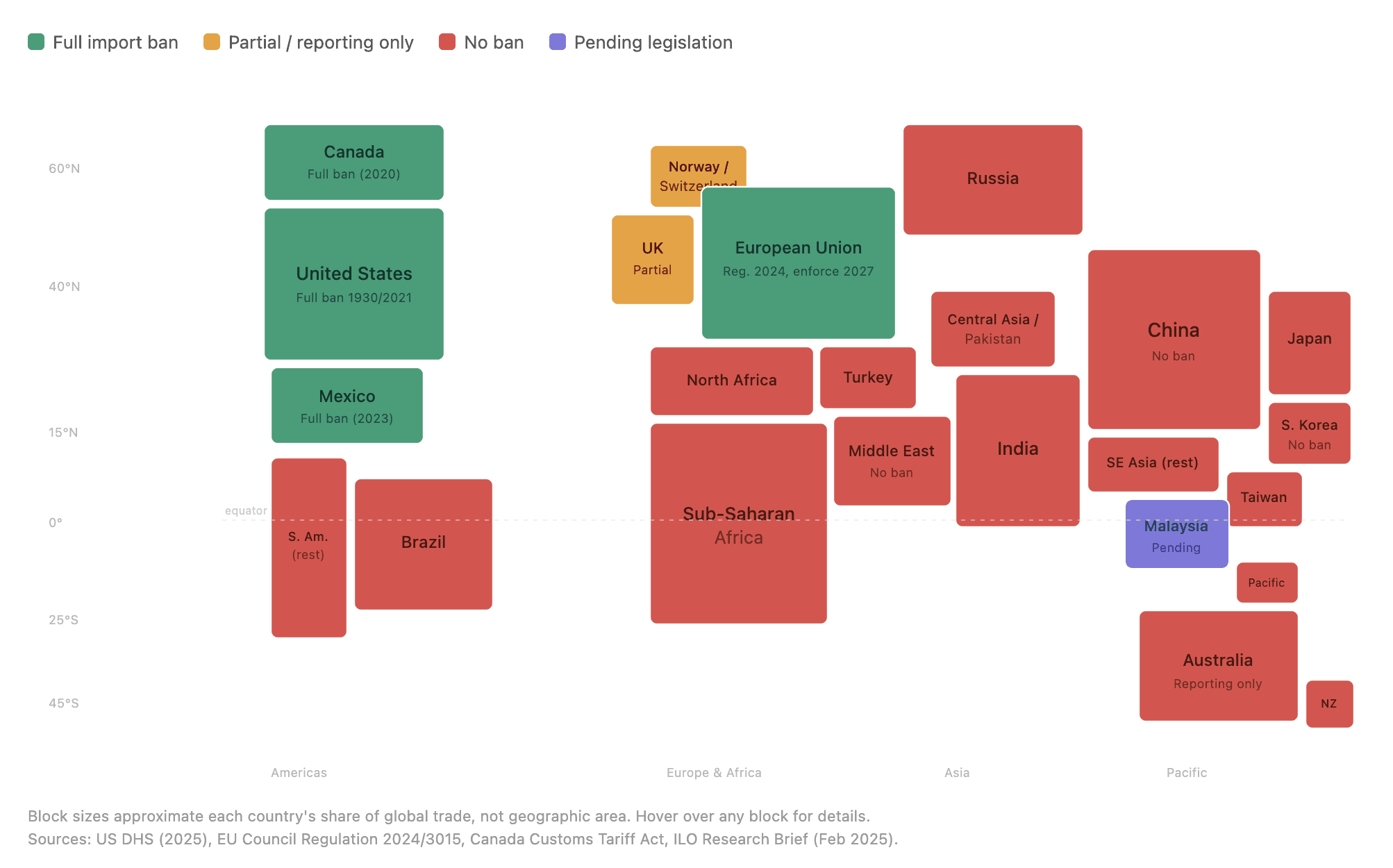
But the US is nearly alone in having this kind of binding, enforceable import prohibition. The table below shows where major economies stand:
Status | Countries / Blocs | Key legislation |
Full import ban | US, Canada, Mexico, EU | Tariff Act s.307; Customs Tariff; EU Reg. 2024/3015 |
Partial / reporting only | UK, Australia, Norway, Switzerland | Modern Slavery Acts; Transparency Act — disclosure only, no import ban |
No specific law | China, India, Japan, S. Korea, Brazil, Russia, most of Africa, SE Asia, Middle East… | None |
Pending / in transition | Malaysia | Required by US-Malaysia trade agreement (2025) within 2 years |
The European Union adopted its Forced Labor Regulation in November 2024, but enforcement doesn't begin until December 2027. Canada and Mexico both enacted bans as a condition of the 2020 USMCA trade agreement. Malaysia is the only country currently in transition — compelled by a new bilateral trade deal with the US to enact a ban within two years.
For a full interactive map showing every major economy's status — including hover tooltips with the specific legislation in each country — explore the cartogram here.
Why the map matters: the dumping ground problem
The countries with full import bans — the US, Canada, Mexico, and the EU — collectively represent a large share of global consumer spending, but they are a small fraction of the world's trading nations. Everywhere else, there is no legal barrier to goods made with forced labor entering the market.
This creates what researchers call a dual market problem. When the US blocks a shipment of solar panels or seafood linked to forced labor, that shipment doesn't disappear — it gets redirected. The International Labour Organization flagged this concern explicitly in a February 2025 research brief, noting that without broader adoption, forced labor bans in some countries risk making others into de facto dumping grounds for tainted goods. The problem compounds at the supply chain level — companies can route production through third countries to launder the supply chain's origin.
This is precisely why the USMCA forced labor provision was seen as a model at the time of its adoption: by requiring all three North American trading partners to maintain bans simultaneously, it closed off the most obvious circumvention route within the region. The Section 301 probe can be read, at least in part, as an attempt to extend that logic globally — using trade leverage to push more countries toward adoption.
The stakes of the probe
Whether the Section 301 investigation produces meaningful forced labor enforcement or simply becomes another instrument of tariff pressure is an open question. Trade lawyers quoted in coverage of Wednesday's announcement were candid that the administration's investigative process was likely more about building a legal record to justify tariffs than about genuine fact-finding. The administration has set an aggressive timeline: public comments by April 15, a hearing around May 5, and conclusions before the July 24 deadline.
But the underlying policy argument — that forced labor bans need to be widely adopted to be effective — is sound regardless of the administration's motives. A world in which only a handful of large economies prohibit forced-labor imports is a world in which forced labor remains economically rational for producers. The goods simply flow to wherever the rules are weakest.
The 60-plus countries that may be named in the probe represent an extraordinary breadth of the global trading system: major Asian manufacturers, most of Africa and Latin America, the Middle East, and large swaths of Southeast Asia. The probe's outcome — whether it leads to tariffs, negotiated commitments to enact bans, or nothing at all — will say a great deal about whether the world is serious about closing that gap.
Explore the data
We've built an interactive cartogram showing the forced labor import ban status of every major economy, sized by trade weight. View the full interactive map →